
Our Service for you
At RBP, we are here to help you!
Discover our comprehensive service area and our RBP distribution partners worldwide. If you would like further information or direct contact, we are here for you.

At RBP, we are here to help you!
Discover our comprehensive service area and our RBP distribution partners worldwide. If you would like further information or direct contact, we are here for you.
Content
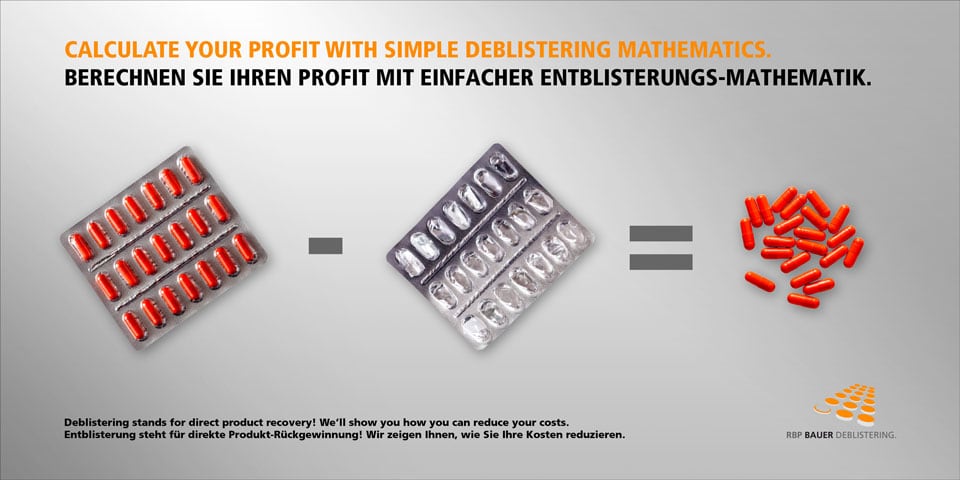
All blister packs rejected in the course of a production process contain valuable pharmaceuticals. If these highly sensitive products are not returned immediately to the current batch packaging cycle, substantial losses will be incurred.
In the following cases, RBP deblistering machines may be used to recover your products:
Efficient deblistering increases the efficiency of blister lines. Using RBP machines allows skilled staff to be assigned to more productive tasks, enables the recovery of expensive products and significantly reduces waste disposal costs.
PVC/AI, Mono, AI/AI; with and without perforation;
even child-proof push-through types; blisters fed crosswise, lengthwise or diagonally, also separation of product rows.
All commonly used materials including AI/AI; with and without perforation;
also suitable for very sensitive products in push-through blisters.
Yes, deblistering helps reduce waste because products can be recovered from packaging and reused.
“GMP-compliant” stands for “Good Manufacturing Practice” and refers to best manufacturing practices in the pharmaceutical and food industries. When something is emptied in a “GMP-compliant”…
Challenges can include packaging variations, product integrity and efficiency. These challenges are solved with precision machinery and monitoring.
Effective and reliable recovery of valuable pharmaceuticals from defective blister packs is of great importance, both for economic and quality reasons. Here are some general…
Deblistering is a process in which medicines or other products are removed from blister packs (also known as blister strips or blister trays). Blister packs…
Deblistering machines are used in various environments and industries where blister packaging is used. Here are some examples of environments where deblistering machines are useful:…